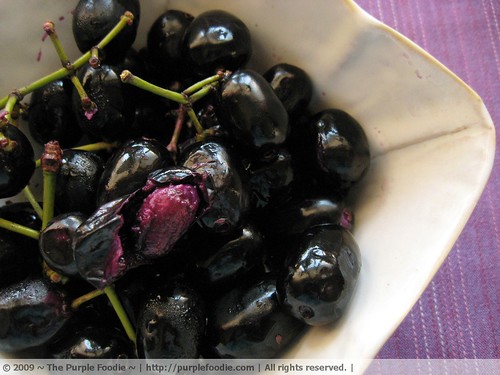
What makes an Indian summer better? Jamuns!

May 15, 2009

Jamuns (aka jambuls, jambun or java plums) are fruits that are exclusive to the subcontinent. And for once, I’m happy to say I’d have these over any of the berries (or rather the lack of them) I’ve been crying over. No, I don’t need raspberries,cranberries and blackberries, I’d much rather have jamuns.

Jamuns are fruits with a blackish-purple skin. They can be white inside with a purple seed or deep purple all together. Come to think of it, they look like large black olives. When they’ve just begun entering the market they’re usually quite tart, but as they mature, they still have the characteristic zing but are much sweeter. They’ve got an astringent after taste that will keep reminding you of the flavour and you will end up eating a lot more of these than you intended!
Jamuns start making their appearance during early April and are found through June on every other busy street with women selling them by the kilo. There are a few jamun trees in my apartment complex as well, but I’d need a huge bamboo stick and a taller person to help me get those down! Each time I see the fruits on the tree I’m reminded of the summers of my childhood. All the girls in the neighbourhood would come out with their bicycles and run amuck though the sunny days. We’d pluck jasmine flowers to make tiny garlands, we’d make tents with bedsheets between two trees, we’d play with the turtles that resided in the fountain (well, here I’d just be watching) and we’d run around with vessels picking up jamuns that some of the older boys would pluck with bamboo sticks. Jamun picking was my favourite part. After collecting as much as I could, I’d run back home to show mum my new found treasure. Mum would then rinse them in running water, drain them and then put them in a saucepan with a little rock salt and shake it up together with the lid on. This way, they become nice and mushy, with the salt beautifully rounding off the tartness. No sooner were they laid out in a plate than I’d be on a marathons of sorts – eating up as much as I could, and in the process not just staining my fingers and tongue a shade of deep purple, but also my clothes (much to my mum’s chagrin).
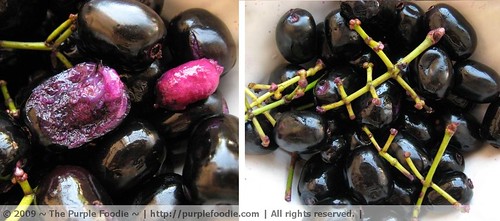
Even today, that is exactly how I enjoy my jamuns – pounded until tender with a pinch of salt. Jamuns are used to make preserves, sauces, tarts and jams as well. I haven’t tried cooking the fruit but I’m curious to know how it would taste. Maybe I will give it a shot sometime. They can also be made into sherbets, sorbets, syrups or pulpy drinks. I recently discovered that the jamun fruits are even fermented into wine in some parts of India!
I’m sure most of you would have never heard of this fruit, but when you’re travelling to the subcontinent during the summer, keep your eyes peeled for these.

{ 76 comments… read them below or add one }

1 UK February 7, 2012 at 9:26 AM

We had 2Jamun trees in our bunglow.We had a lot of jamuns during summer.
Jamuns & raw mangoes eaten in afternoon keeps body cool during summer.

Reply

2 Rekha May 28, 2012 at 3:47 PM

They’re not exclusive to the subcontinent. They also grow in parts of the Caribbean.

Reply

3 Raul Brammin June 17, 2012 at 11:11 AM

Rakha… as a matter of fact they ARE exclusive to the subcontinent…

They were introduced in the Carribean island by indian slaves and the colonies that ruled the region.

You definitely would like to read history a bit more , now wouldnt you ;) ???

Reply

4 Rajendra July 18, 2012 at 4:53 AM

Not Indian slaves but indentured servants.After slavery was abolished in the Caribbean and Guyana indentured servants were brought in to do the work of the ex-slaves.So their likes for fruits and food were introduced in the areas where they settled.

Reply

5 Phoenix June 5, 2012 at 3:57 AM

I agree with you.. I’d give up all the berries in the world, just to eat JAMUNS again.. So many childhood memories are connected with this most precious purple berry.. I simply can’t wait to be in India this summer to eat Jamuns with my newlywed love :)

Reply

6 Monu June 6, 2012 at 1:37 AM

I am growing 2 jamun trees in New Jersey, USA. They are still small. During winters, I take them inside – where it is warm. For a few years I will have to keep doing that. Hopefully, when they are big – they will be able to survive the winters on their own.

Jamun trees are growing successfully in Texas, CA and other warm & moderate climate states.

Jumun’s the fruit from Heaven ! :-)

-Monu.

Reply

7 jamun lover November 15, 2012 at 2:35 PM

Monu
Where did you get the seeds? I haven’t had jamun in over 38 yrs. I’m in PA now and would love to start my own tree. Please email me at mzee3421@gmail
thanks

Reply

8 manu May 10, 2013 at 4:28 PM

Hi
I grew from the seeds that i bought the fruit from ,ate the fruit and saved the seed dry in the sun for a month then put them in the pot .Sprouts came out within 3 weeks . Now I am looking for somebody to take over my JAMUN TREE because it is too big for my house. I live in north of CANADA so I cant think of putting in the ground to survive in winter.

Reply

9 Minu May 11, 2013 at 10:03 PM

I would love to buy your jamun plant if you still have it
I live in ca
thanks

Reply

10 mamun.pb June 24, 2012 at 2:09 PM

my hot favorite frouit is jamun.unfortunately jamun found very short time.havy rain reduce the growing of jamun frouit.i am bangladeshi,you found it in summer at middle of the june in whole indian subcontinant.

Reply

11 Cami Loutan September 6, 2012 at 5:25 PM

I,m from Trinidad & Tobago and we got lots of jamun trees here. Iremember eating these fruits in my teenage years

Reply

12 Alain November 13, 2012 at 2:29 AM

exclusive in India? How did it came to the Philippines?

Reply

13 Karina December 22, 2012 at 11:17 PM

How so very true!!!! I grew up in central Afica in a country called Zambia and believe me the jamuns there are the very best that I have EVER tasted, and yes I have lived in India for a number of years and tasted jamuns of all seasons. Smply no comparision but we have to take into account that each country has its own unique type of soil!!!
But now I live in USA and my jamun tree is about 8 feet tall, and its about 2 years old. But a friend of mine lives in Orlando and that tree is a 100 feet tall and during the season which is around July/August, and they enjoy literally thousands of jamun!!! But certainly nothing like what we had in Zambia!!!
And that accounts for 3 different continents, so I have to say that like most things, the seeds travel with travelers!!!!!!!!!!!!

Reply

14 Zaman March 24, 2013 at 2:21 AM

Can u give me the address in orlando for the tree. Maybe I can get the seeds

Reply

15 kerriann springer March 2, 2013 at 7:04 PM

THe Jamun tree can also be found all over Barbados, in the Caribbean.

Reply

16 belinda March 22, 2013 at 11:03 AM

cn someone tell me how much per kilogram i should pay for Jamun fruit??

Reply

Leave a Comment

{ 1 trackback }

Previous post:

Next post: