Posts tagged as:

cheese

Mascarpone Cheese

Left: Easy, homemade Mascarpone cheese, Right: Tub of Italian mascarpone cheese

Last week was a fun week filled with lots of experiments in the kitchen. I had the strongest craving to replicate the Tiramisu that I ate on my first evening in Verona. That Tiramisu changed my life (more on that in the Tiramisu post).  Tiramisu is generally about assembling ingredients: readymade mascarpone, and store bought Savoiardi biscuits whipped up together. To set myself a challenge, I decided to make everything from scratch. Starting with the mascarpone cheese.

Making the cheese was an adventure, and a fantastic learning process. I even ended up with Mascarpone di Purple Foodie. No kidding.

I wrote to my friend Benny who runs the La Ferme Cheese Factory in Auroville (they make the most amazing chèvre.) to seek his opinion of what my new cheese discovery might be. That’s when I thought that sharing the details of that email might be helpful for those attempting to make mascarpone at home.

“Hi Benny,

I’m very excited to report to you my latest cheese making episode.

I attempted to make mascarpone, and it was a success. It probably one of the easiest cheeses to make!

The process I followed:

Mascarpone Cheese

Cook Time: 15 minutes

Total Time: 1 days

Yield: 600g

Ingredients

  • 1 litre cream
  • 1.5 limes, juiced

Cooking Directions

  1. I heated the cream to 190F over a double boiler. Stirring it every little while. It took about 15 minutes to reach this temperature.
  2. After this, I squeezed in the lime juice.
  3. The cream curdled, but not as frantically as it does for paneer/ricotta.
  4. I stirred it, so that the lime juice is mixed evenly.
  5. The cream began to thicken and I turned off the heat after the mixture was of consistent texture.
  6. I let this sit for about 15-20 minutes to cool.
  7. After this, I poured it over a sieve lined with a cloth over a bowl to drain off the whey.
  8. I let it sit outside till it was completely cool,
  9. After that I tied up the cloth and let it sit in the sieve over the bowl in the refrigerator overnight.

1st attempt:

I used Parsi dairy cream. It’s richer than Amul cream, and I used this thinking I’d get a very creamy mascarpone cheese. The results of this were pretty disastrous. The cream did not curdle even after adding juice of 2 limes. I heated it directly over the stove thinking it would curdle then. It still didn’t.  Then, I finally poured the mixture over a cheese cloth hoping that maybe I didn’t notice the curdling process, because I read that it isn’t as frantic as paneer/ricotta. What I got was this sour tasting shiny cream/butter.  I think this happened because one of the packs of cream had turned sour. I used it anyway thinking it might aid the cheese making process with its acidity. It does not.

Buttery Cheese

Firm, buttery cheese (weird). It melted into a buttery liquid on heating.

Fluffy, sour creamy type, buttery cheese

Fluffy, sour creamy type, buttery cheese.

2nd attempt:

I used Amul cream. Everything was perfect when I untied the cloth the next day. As a taste test, I even bought a tub of Italian made mascarpone cheese. It tasted very, very similar. Except that the Italian one was slightly sweeter and creamier with lesser water content. That’s the following photo. You can see that the water content in my home made version was higher and the cheese wasn’t sitting on the spoon perfectly. I needed to get rid of this excess water content.

Mascarpone Cheese

Almost Mascarpone, almost!

Instead of waiting for the whey to drip off for a few hours, I started massaging and squeezing the cheese in the cloth to drain off the whey. I got rid of loads of it. But when I opened it, I noticed that the texture changed. It wasn’t the mascarpone texture anymore. It had turned slightly grainy with fat globules and had a distinct yellow tinge to it. I thought that this was the end of the tiramisu process (for which I was making the mascarpone). But as a last resort to salvage the cheese, I tossed it into the bowl of my KitchenAid to see if it gets back its creamy texture on whipping. What happened was amazing – the cream came together and separated from whey and then what I got was this creamy yellow cheese, blobs of which I squeezed by hands and transferred to another bowl. It was silky smooth, without sticking to the fingers like cream or mascarpone cheese usually does. It was like touching melted mozzarella without the grease. That’s the following photo, where it’s kept in comparison with the Italian mascapone. What I wanted to know from you is what kind of cheese did I really end up with? (Dear reader, now is when you chime in) It’s got higher fat content than mascarpone, and tastes richer. It definitely was an additional step after mascarpone-making that I discovered by accident.

Mascarpone Cheese

Mascarpone di Purple Foodie (for real!)

3rd attempt:

I followed the process described above in the recipe to the T. No poking, prodding, squeezing, massaging. What I got was absolutely clear whey (as compared to the milky whey in the 1st attempt). That’s the following photo. The cheese sat in the cloth for 1.5 days before I transferred it to a container. Here is the luxuriously thick and creamy homemade mascarpone cheese that I’m quite proud of. 3rd time lucky!


Mascarpone Cheese

Creamy, homemade Mascarpone. Finally.

Please let me know what you think the result of my 2nd attempt really is. I’m quite thrilled with my cheese making attempt and can’t wait to move on to more risky things with rennet.

Be well.

Shaheen”

In his reply, Benny tells me “In the second attempt you changed the structure by kneading and whipping; some change had to happen by doing this and I think you had the good luck of a good result. I really don’t know if your result corresponds to something already done and produced. You may have invented your own quality Mascarpone.

Additional notes:

  • The mascarpone cheese used for comparison is Italian made Zanetti mascarpone.
  • I used an Ikea instant read thermometer to measure the temperature of cream. In case you want one, here’s a good option.
  • While I used 25% fat cream that locally available, you can (and must!) use richer cream with 36% fat, if it’s available to you.
  • You can also use lemon juice instead of the lime juice that I used.

Conclusion:

  • Parsi dairy cream, with its 3 day shelf life, is highly unstable for cheese making, however tempting the high fat content might be.
  • Draining the mascarpone for 1.5 days results in a cheese that’s even thicker and creamier than Italian mascarpone. A day’s worth of draining is sufficient.
  • The homemade mascarpone isn’t as sweet as the Italian version, but it does measure up to the Italian mascarpone and is worth the effort.
  • Best of all: It costs 5x less than store bought.

So there it is. My Mascarpone cheese experiment.

{ 71 comments }

Honey, Walnut and Fig Cheese Spread

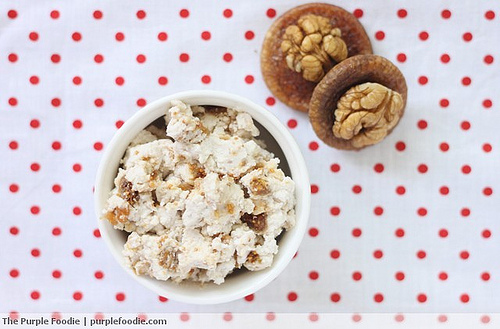
When I was in Paris a few months ago, I was lucky to be living in the cutest little apartment with a well stocked pantry and the most gracious host. That’s where I first got a taste of this delicious cheese spread – light fluffy, sweetened with honey, and crunchy with walnuts and figs. I ate it spread on a baguette, slice after slice.

I’d never imagined I’d like my cheese sweet or I’d enjoy pieces of nuts in it. I’m usually the kind that carefully picks out cashews and almond from my food. But with this cheese spread it didn’t feel one bit odd. It was perfect. The subtle sweetness from the honey, the mild bite of the softened walnuts and the crunchy seeds of figs all worked in unison.

I brought back tubs of the cheese back home, but that didn’t last too long. With the yearning to replicate that flavour, I set out to make the cheese spread of my rêves. I started with whipping up equal quantities of cream cheese and cottage cheese together. The cream cheese brings in the tanginess, whereas the crumbled cottage cheese is perfect for a fluffy volume and a pleasantly inconsistent texture. To that I added a handful of roasted walnuts that dried figs that I chopped up. This is a chunkier version of the cheese spread with extra walnuts and figs. If you’d like a smoother version, you can cut the dry fruits by half.

Honey, Walnut and Fig Cheese Spread

Fig, Walnut and Honey Cheese Spread

Ingredients

  • 4 oz. / 125g. cream cheese (Philadelphia)
  • 4 oz. / 125g. cottage cheese, crumbled
  • 1.5 oz/ 50g. dried figs and roasted walnuts, chopped
  • 1 tbsp honey

Cooking Directions

  1. In a bowl, add the cream cheese and cottage cheese and gently whip together until evenly incorporated and slightly fluffy. It’s best to do this when both the cheeses are at room temperature.
  2. Next, add in the dry fruits and stir till they’re evenly distributed.
  3. Finally, stir in a tablespoon of honey for sweetness.
  4. Transfer to a container and store it in the refrigerator for a little while for the flavours to meld. Spread on bread or eat by the spoonfuls.

{ 22 comments }

Provolone Valpadana

February 8, 2011

Provolone Valpadana

I’m going to tell you about one of the most enjoyable things I did during my recent trip to Italy - Watching the production of Provolone Valpadana cheese at the Auricchio factory in Cremona. Cremona is a city in Northern Italy that is known for its musical history and traditions, and is the heart of the Provolone production zone. One of the oldest cheese making companies in the city is Auricchio. The Provolone cheese they produce, called Provolone Valpadana, has been conferred the P.D.O. (Protected Designation of Origin). Like the title suggests, the entire sourcing, production, and processing takes place only in that defined geographical area – Northern Italy, in this case.

The story goes that Gennaro Auricchio invented a special type of rennet (milk coagulant) which was called Don Gennaro’s “secret”. This is what gives Auricchio Provolone its unique flavor.  While Auricchio does produce other types of cheese, its name has become synonymous with Provolone cheese.

A morning at the cheese factory…

As soon as I wore the hairnet and paper-y coat, and covered my boots with plastic, I was beaming. This was my Cheese Slices moment. Something I’d only seen on television up until this point. I was entering my Disneyland.

Purplefoodie at the cheese factory

Early every morning the milk delivery trucks roll into the factory. The whey from the previous day’s cheese making process, along with some rennet, is added to the milk – calf rennet for dolce (mild) cheese, and goat rennet for piccante (strong).  Once the curd is formed, the slabs are left to rest for 2-5 hours.

Provolone Valpadana

The cheese curd is then put through a machine to obtain the stretched curd. This is the most important step in the production of Provolone Valpadana. The action is known as “filatura”, and the resultant curd is called, “formaggio a pasta filata”. (below, right)

Provolone Valpadana

Usually, two men pair up to knead the fresh cheese. PS: Any fuzziness in the photos that you might see is wholly attributed to the steam from the boiling water.

Provolone Valpadana

They knead the cheese (what a work-out), and as they’re doing so they keep pouring hot water over it. Almost boiling water. Which is why you need these strong men to take charge. Of course, they knead some love in as well.

Provolone Valpadana

Next, it’s time to shape the cheese. They either roll it up into a cylinder (left) to fit into the mould, or shape it by hand.

Provolone Valpadana

The moulds are then transferred into a big machine that will submerge them into cool salted water to harden the form. This takes just a few hours.

Provolone Valpadana

Depending on the size of the cheese, it is left in the brine for 2hours – 15 days.

Provolone Valpadana

The Provolone cheese is ready to be aged. Again, the maturation time depends on the size of the cheese. Typically, the Dolce(mild) Provolone Valpadana is aged for a maximum for 5-6 months and the Piccante(Strong) is aged for  6 months – 1 year.

Provolone Valpadana

The cylinders of cheese are then tied up snugly, ready for ageing.

Provolone Valpadana

Provolone Valpadana

Ta-da! Auricchio Provolone ready for consumption.

Provolone Valpadana

Smoked provolone.

Provolone Valpadana

Walking through the Auricchio, I was overwhelmed. Cheese as far as the eye can see. Cheese from floor to ceiling.

Provolone Valpadana

More cheese: Parmigiano Reggiano and Provolone mandarino. While the Grana Padano and Parmigiano Reggiano are not produced here, they are packaged in the same plant.

Provolone Valpadana

What we couldn’t photograph was the packaging process. But I can tell you that I was left utterly amazed by the efficiency, accuracy, and technology used.

Aaand then, finally, it was tasting-time! We sampled the dolce, piccante, affumicato (smoked) Provolone as well as peppery Pecorino, Parmiggiano Reggiano. Needless to say, we didn’t really need lunch after.

This trip to Italy was sponsored by the Italian Government and the EU as a part of the European Art of Taste (EAT) Program.

{ 17 comments }

Herb butter mushrooms with smoked mozzarella

A few months ago when a friend requested I make mushrooms for an office potluck, I was instantly reminded of a recipe I had from my rounds at the city’s chic restaurants where the chefs demonstrate recipes, let you sample some and give you copies of the recipe. I loved going for these and making local foodie friends. Most places gave a bag of goodies and even spread out a buffet of the food demonstrated (much to my glee). At one such restaurant, I had the most delicious stuffed mushrooms topped with Danish mozzarella. Full of flavour and distinctly garlicky – YUM!

So as soon as mushrooms were requested, I went looking for my recipe file. I looked around the house and ended up finding it months later(today!) in the loft where mum had tucked away a gazillion recipe cut-outs, food books and magazines of mine. I was ecstatic!to finally find my recipe file! Oh, but wait a minute, the entire set from that restaurant was missing – back to the drawing cutting board.

With some button mushrooms at hand today, I craved for those plump stuffed garlicky mushrooms topped with mozzarella cheese and grilled under the broiler until just done. I had to recreate it.

Herb butter mushrooms with smoked mozzarella

I wiped the mushrooms clean, twisted the stems, chopped them up and brushed the mushrooms with some olive oil. Next, I minced 4-5 cloves of garlic with a few sprigs of thyme (excellent fragrance; getting there!), mixed it with the chopped stems and stuffed the mushrooms back with it. How do I make them plump and moist, instead of making them look dry after coming out of the broiler? I cut up some cold butter into tiny cubes and topped the stuffing with it, so as it heats, the butter seeps in and keeps the inside moistened. Next, I sliced some smoked mozzarella and topped the stuffed mushrooms with it. Finally, seasoned it with salt and pepper and pushed it under the broiler. In a little over 5 minutes, the cheese was bubbling, the kitchen was fragrant and the juice in the pan was totally lick-worthy!

These mushrooms turned out way better than I expected. The next time I make it, I’m going to make sure I double triple the quantity!

Herb Butter Mushrooms With Smoked Mozzarella
Serves: 2

8 oz./225g button mushrooms or cremini mushrooms
4-5 cloves of garlic, minced
4-5 sprigs of thyme leaves
15g/1tbsp cold butter, cut into tiny cubes
Olive oil to brush the baking sheet and mushrooms
1 oz./30g smoked mozzarella or Danish mozzarella ( I prefer smoky flavours, any day)
Salt and pepper
Scant handful of chopped parsley for garnish

  1. Brush the pan with olive oil and place the mushrooms gill sides up with the stem removed.
  2. Chop the stem and mix it with the garlic and thyme and stuff it back into the mushroom.
  3. Dot the mushroom stuffing with cold butter.
  4. Brush with olive oil and top it with thin slices of mozzarella cheese.
  5. Season with salt and pepper.
  6. Slip the pan under a broiler for 5-7 minutes or until the cheese is bubbling and the mushrooms fragrant.
  7. Transfer to a plate, garnish with cilantro and serve immediately!

{ 49 comments }

Baked mac and cheese

Six cheese macaroni does sound over the top. But you’d do this too if getting your hands on some good cheese was as big an event for you as it was for me. This past week, I stumbled upon a variety of cheeses at my local supermarket. A dull day suddenly became a lot more exciting as I kept throwing in slab after slab of cheese into my cart. Soon enough I began thinking of all the ways I’d use my cheese. Cheddar biscuits had been on my mind so I got down to making them first. A good mac and cheese was on my list next.

Rigatoni pasta

Cheese and cheese sauce

Of course I didn’t start with six cheeses in my mind. When I began thinking about how I’d make my mac and cheese, a three cheese pasta was where my heart was first. But as I put together all my cheese on the table, I realised I could be a wee bit dramatic and instead make a six cheese mac. Just thinking about this, made me a happy, happy girl. I made a sauce that would combine my favourite cheeses and be tossed with some rigatoni and baked until golden with a sage, breadcrumb parmesan crust.

Mac and cheese and sauted veggies

Six Cheese Mac and Cheese
Serves 4 hungry people

Pasta:
250g dried pasta (elbow macaroni/penne/rigatoni)
Salt
Water

Cheese sauce:
3 tbsp olive oil
1 medium onion, chopped
3-4 cloves of garlic, minced
1 tsp chilli flakes/red chilli powder
2 tbsp all purpose flour
2 cups/500ml Cups milk
1oz/25g Blue cheese (you could use more, I ran out of it)
10z/50g Goat’s cheese (mine had added herbs)
2oz./50g Smoked gouda
2oz./50g Colby cheddar
20z./50g Sharp cheddar
Salt and pepper to taste

Sage, toasted breadcrumb and parmesan crust:
2 oz./50g Parmesan
½ cup Bread crumbs, lightly toasted for 1-2 minutes.(sometimes, I add 1 tbsp butter)
5-6 sage leaves, chopped (you can sub it with your fave herb as well)

  1. In a large pot, boil the pasta till just about done or al dente. Drain. Set aside.
  2. In a saucepan heat the 2 tbsp of the oil and then saute the onions for 3 minutes. Add the garlic. Continue to saute until the onions are translucent, 2 more minutes.
  3. Add in the remaining 1 tbsp of olive oil and add in the flour and stir till all the oil has been absorbed.
  4. Whisk in the milk, a little at a time, until all the milk has been incorporated and the sauce is thick enough to coat a spoon. Stir frequently for about 5 minutes.
  5. Stir in the cheeses until uniformly blended.
  6. Toss the pasta in the cheese sauce and add salt and pepper as desired.
  7. Toss the parmesan, sage and breadcrumb together for the crust topping.
  8. Transfer this to a buttered5″x3″ glass baking dish or a gratin dish and top it with the bread crumb mixture.
  9. Bake it in a preheated oven at 375F/190C for 30 minutes or until topping is golden brown in colour.
  10. Let it sit for 5 minutes before serving.

{ 23 comments }