
If you're new here, subscribe to the RSS feed for regular updates direct to your Feedreader. Thanks for visiting! 

Cinnamon, sugar and butter between slices of dough and baked to a warm hue. How can you resist?
It looks all fancy schmancy, but it’s really simply to make. It’s the basic plain white bread dough. You just do a little bit of rolling, spreading and slicing. Shove it into a loaf pan, and then let time and the oven do its job. I’m one of those that believe that there is no such thing as too much cinnamon; so I’m not shy at all about how much I use.
And you know, this bread is pretty genius. You don’t have to bother slicing it – you just peel it apart slice by slice. It’s rather fascinating doing so – watching the slices come apart, as you get hit by a whiff of cinnamon. It’s joyful. It’s comforting. And then you bite into soft, pillowy, flavourful bread.
The cinnamon pull-apart bread is best had minutes after you’ve baked it. I baked two large loaf pans and didn’t have any leftovers. But if you do, then there is no better use of the bread than making yourself some French toast. Heaven on a plate.
Inspired from Joy the Baker, I made the cinnamon sugar pull-apart bread using my go-to soft white bread recipe (Don’t be fooled by its use in the pesto bread roll – that’s just how versatile this bread recipe is.)

I was jubilant when I spotted tiny yellow tomatoes at the market a few days ago. Given their size, I could either toss them into a salad or top them on a focaccia. No prizes for guessing what I opted for.
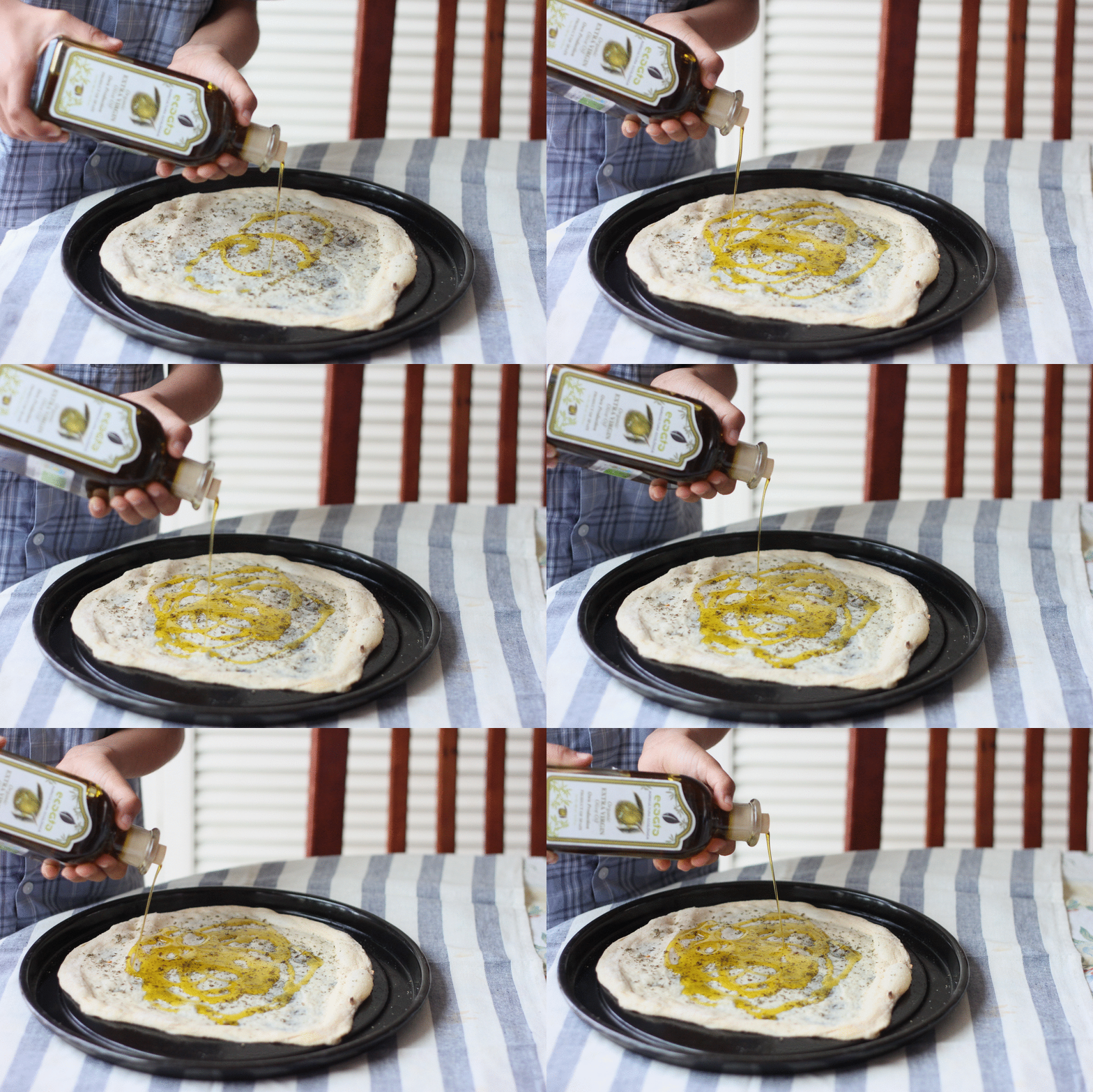
These tiny tomatoes pushed into the focaccia dough come alive with the sprinkling of rosemary. Doused with extra virgin olive oil, and torn into when still slightly warm, this bread brings so much joy.
I used my favourite focaccia recipe from Peter Reinhart (and yet again, it’s him. Maybe I should apply for the job of being his official evangelist, if there is such a thing). Here is where you can find the recipe.

I recently rediscovering the joys of truly amazing extra virgin olive oil. Over the past week, there has been nothing I’d rather snack on late at night than slightly toasted bread, sprinkled with crunchy sea salt and doused in extra virgin olive oil. After trying out the multi grain bread from Yazdani for a few days, I decided I’d make something fragrant, something slightly experimental.
I leafed through my current favourite bread book and stopped at focaccia (perfect, considering the Italy theme – Italian Bread, Italian Olive Oil, cooking in Italy). I thought I’d play a bit with the topping and decided on using grape and rosemary because the flavour pairing has been on my mind for a couple of weeks now. This is surprising, because I’m not usually the type to experiment with fresh fruits in bread. I’d happily use dried berries and nuts, but fresh fruits? Not really. I suppose it was the thought of having bread mottled with purple juices from the grape that got me excited. I felt utterly proud of myself for having thought this up. But my moment lasted all of 30 seconds – for I found the grape-rosemary pair already mentioned in my beloved Flavour Thesaurus. (I hope to discover a flavour pairing not mentioned in the book, and then proudly email the author. One day.)
I call this a wannabe focaccia because although I had every intention of making a focaccia, I underestimated the dough’s rising capacity. I filled my pan with more dough than required, thus resulting in a not-so-very-flat flatbread.

I used the recipe from Artisan Breads Every Day (US | UK | India), and I suggest you get yourself a copy if you’d like to make your own bread – it’s a book with stunning recipes that don’t end up intimidating you. I’ve used this book several times (remember the chocolate and cinnamon babka, or the pesto bread rolls?) and I keep going back to it. I stuck to the focaccia recipe, except that I added a load of fresh black grapes, a sprinkling of dried rosemary, and a dusting of brown sugar (for a little browning) on top of the dough a few minutes before I popped the dish into the oven for baking. The instructions for the focaccia are a little more detailed to be replicated on the blog, but if you’d like, here is another recipe for focaccia.

I’ve got to admit, I’m quite a hoarder when it comes to hard-to-find ingredients. The problem with food shopping for me is that I always buy more than I should because, you know, I am utterly positive that I will never find it anywhere else. I bring sneak it back home and then find a spot for it in my ‘special’ cabinet, never to see the light of day. What’s worse is that many a time a lot of the stuff ends up in the trash can because it’s crossed its prime. Oops!
Today I pulled out my pack of Swedish Pearl Sugar that I got from Ikea last year. Don’t roll your eyes; the sell by date is Nov 2011. So, in fact, you should be patting me on my back for breaking into this well before time. So, what prompted me to reach into my special cabinet? The awesomeness from Spain, of course. Every time I get my hands on more ‘exotic’ ingredients, I feel like I deserve to use some of the precious ingredients from that cabinet.

I set out to make cinnamon sugar rolls, just like the pack of sugar suggests. I used my go-to book for bread these days, Artisan Bread Every Day for the sweet dough recipe. And as the name suggests, I packed it with a very generous spread of cinnamon, sugar and butter. Here’s a tip: add vanilla extracts to make your sweet dough. It makes the dough smell unbelievably irresistible. You just might eat it raw.

Cinnamon Sugar Rolls
Yeild: 10 big rolls
Adapted from: Peter Reinhart’s Artisan Breads Every Day (US | UK | India)
Dough
2 ½ tsp instant yeast
8.5oz / 240g milk
14 oz / 400g flour
1 tsp salt
45g sugar
50g melted butter
1 tsp vanilla extract
Filling
50g butter, softened
100g sugar
2 tbsp ground cinnamon
Topping
Eggwash (beaten egg with a little milk)
Swedish Pearl Sugar
- Whisk the yeast into the milk until dissolved.
- Combine the flour, salt and sugar together. Pour the milk, melted butter and vanilla extract over the dry ingredients.
- Knead the dough either by hand or using the dough hook attachment of the KitchenAid and knead until the dough is soft and slightly sticky. If using a KA, it should clean up the sides of the bowl and only stick a little to the bottom.
- Place the dough in a lightly oiled bowl, cover it with a plate or some plastic wrap and let it rise for 1-2 hours (depending on how hot it is where you are), or until doubled in size. You can refrigerate this after this point for up to 4 days.
- Punch the dough back down and roll it out in a 12×15 inch rectangle. Spread the butter evenly on the dough and sprinkle the cinnamon and sugar over it. Roll up the dough tightly and cut into 1½ inch slices.
- Place it into a buttered 9 inch pan, making sure to keep it well spaced out. Let it rise for 1-2 hour.
- Brush the dough with egg wash and sprinkle on the pearl sugar.*
- Bake in a preheated oven at 175C/350F for 18-20 minutes, making sure to turn the pan halfway through baking.
- Wait for it to cool a bit and then transfer the pillow-y goodness to your mouth!
* Of course, you don’t need to use pearl sugar – you could make a caramel glaze or perhaps coat it with some Dulce de Leche.

I’m thrilled with my second success of bread in a row, and that too with a new bread recipe instead of my go-to focaccia recipe. And I think I’d like to attribute the success to two things: Peter Reinhart’s Artisan Breads Everyday and instant yeast. You’ve heard me sing praises of this book when I made the chocolate cinnamon babka, so I won’t go down that road. But instant yeast? It’s magical.
So, what are the properties of yeast and which yeast should you use? When compared with fresh cake yeast and active dry yeast, instant yeast wins by far. Here’s how:
- You only need to use a small quantity of instant yeast to get the job done(usually 1/3rd of the commonly used cake yeast).
- Instant yeast has much longer a shelf life, about a year, compared to about two weeks in the refrigerator for fresh yeast. I’ve bought a block of fresh cake yeast several times only to throw away most of it after a few weeks, so the long shelf life really helps. This makes it one of the most important advantages of instant yeast.
- Instant yeast is also very easy to use. You don’t have to wait with baited bread breath for the yeast to dissolve in water and froth up.
- It isn’t as pungent (read: less stinky) as active dry.
- It results in a bread with an amazing texture.

To make the pesto rolls, I first started out with a white bread recipe, using extra virgin olive oil instead of regular. I made the whole recipe and divided it into two batches – one for today’s pesto rolls and the other for another day (the dough can be refrigerated for upto 4 days). And boy, even half the batch made many rolls – 24 to be precise. I made them in 3 pans (a 9 inch square pan, an 8 inch circular pan and a 4 inch springform pan) just to see how they would look in each of them. You can make it in a 9 x 13 inch pan to have it all in one place.
The problem with photographs is that they don’t really bring out the softness within this moist bread. You can rip this dinner roll into two so easily, yet it still retains some stickiness and substance. And the smell. Mmmm, the smell. You can sense the beautifully sweet smell of freshly made bread throughout the house. I would go so far as to say that this is the perfect dinner roll. You must make this bread as soon as can – you’re going to love it!

Pesto Bread Roll Recipe
Yield: 48 rolls
Adapted from: Peter Reinhart’s Artisan Breads Everyday (USA | UK | India)
Bread:
1 tbsp /9g instant yeast
1 3/4th cup / 425g lukewarm milk (any kind)
6 1/4th cup / 794g unbleached bread flour (I used all-purpose)
2 tsp salt
5 1/2 tbsp sugar
6 tbsp / 85g extra virgin olive oil
1 egg for the dough
1 egg for the eggwash
- To make the dough, dissolve the yeast into the milk and let it rest for 5 minutes.
- In a bowl, add all the other ingredients and mix it up as you pour in the milk. Once the ingredients are evenly distributed, start kneading for 4-5 minutes until the dough is soft and supple.
- If you’re kneading using a KitchenAid, knead by hand after you’ve turned the dough out for 2 minutes. Divide into two, make into balls and place it into two bowls greased with oil and covered with cling film. You can refrigerate one bowl for later use and let the other batch rise at room temperature for about 2 hours or until doubled in volume.
- Now roll out the dough into a 1/4th inch thick sheet and spread generously with pesto, making sure to stay away from the sides.
- Form a roll and cut with a sharp knife or a bench scraper and place the individual rolls into the baking tin. Make sure to leave some space between rolls, because they’re going to spread!
- Cover with a cloth or cling film so the bread doesn’t form a dry skin.
- Let the bread rise again for about an hour.
- A little before baking, brush the top of the bread with eggwash (1 egg + 2 tbsp water or milk) to get a gorgeous golden hue.
- Bake in a preheated oven at 180C/350F for 15-20 minutes.
I was hoping to have these dinner rolls for, well, dinner, along with some nice soup or pasta. But *somebody* polished off the entire 9 inch pan of the bread by mid-day. Lesson learnt: Do not ever keep pesto dinner rolls out in the open for anyone to see, smell, or touch before time; they won’t last.